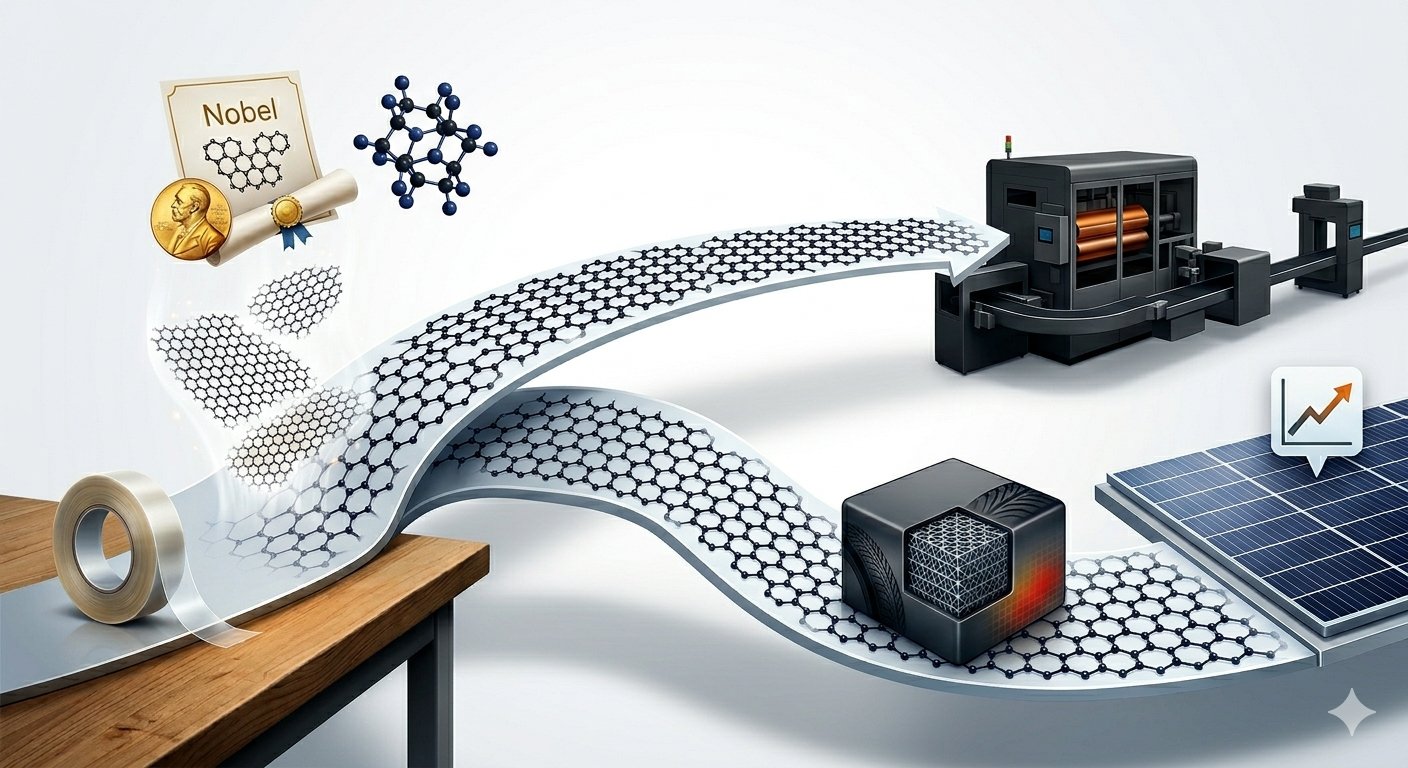
In 2004, Andre Geim and Konstantin Novoselov used Scotch tape to peel single-atom-thick flakes of carbon off a graphite block at the University of Manchester. It sounds ridiculous. It worked. Six years later, they shared the Nobel Prize in Physics.
What followed was one of the most spectacular hype cycles in materials history. Graphene was going to replace silicon in transistors. Replace indium tin oxide in displays. Revolutionize batteries, create unbreakable phone screens, purify water across the developing world, and deliver drugs to cancer cells with surgical precision. Cover the world in flexible electronics. Change everything.
Most of that hasn't happened. Some of it has. Twenty years after that Scotch tape experiment, it's worth doing an honest audit.
What graphene is
One atom of carbon thick. Arranged in a hexagonal lattice. That structural fact produces a set of properties that genuinely are extraordinary: tensile strength roughly 100 times greater than steel by weight, electrical conductivity that exceeds copper under ideal conditions, optical transparency of 97.7%, and near-complete impermeability to gases including helium.
The word "ideal" in that list is doing a lot of work. Lab measurements on perfect, monolayer graphene tell you what the material can do in principle. Getting those properties out of graphene in a real product is a different problem entirely.
The hype, and its peak
The EU launched the Graphene Flagship in 2013 with €1 billion in funding over ten years. The UK government committed hundreds of millions more to commercialization research. Hundreds of companies incorporated "graphene" into their names or product claims.
By 2015, the Gartner Hype Cycle had graphene near the peak of inflated expectations. Patents were being filed faster than for any new material in recorded history. Technology media published regular predictions of mass-market graphene products by 2020.
Most of those predictions were wrong. And the reason they were wrong was understood, at least by working materials scientists, fairly early on. Manufacturing was always going to be the problem. It just took a while for that message to reach the headlines.
What actually shipped
Composites and structural applications
This is graphene's clearest commercial success. Adding graphene nanoplatelets to polymers, concrete, and rubber improves mechanical properties measurably without adding significant weight. Vittoria, the Italian tire manufacturer, launched graphene-enhanced bicycle tires in 2016. Directa Plus, a UK company, produces graphene materials now used in sportswear, vehicle tires, and water treatment. These products work. The graphene loadings are low (fractions of a percent by weight) and the improvements are real but incremental. But the product is on the shelf, and it sells.
Thermal management
Samsung incorporated graphene heat spreaders into several mobile devices between 2014 and 2019. Graphene's lateral thermal conductivity is extremely high, and it distributes heat across a surface more efficiently than copper films of the same thickness. This application quietly disappeared from headlines because heat spreading is unglamorous. But it's working in devices people carry every day.
Filtration and membranes
Graphene oxide membranes for water filtration are arguably the most scientifically interesting commercial development. A team at the University of Manchester demonstrated selective ion filtration through graphene oxide laminates in 2017. Companies including Ionic Industries and G2O Water Technologies are pursuing commercial water treatment and gas separation applications. Still mostly pre-commercial, but with genuine scientific credibility and a clear market need.
Conductive inks and printed electronics
Graphene inks for printing antennae, sensors, and flexible circuits are a real and growing segment. Conductivity isn't as high as silver inks, but graphene inks are cheaper and more mechanically flexible. Several companies produce them commercially today.
Batteries
The picture is complicated. Graphene-enhanced battery anodes, particularly silicon-graphene composites, have been incorporated into a small number of commercial products. The gains in charge rate and cycle life are real but modest compared to early claims. Huawei claimed graphene-enhanced batteries in certain handsets around 2017. Some EV battery manufacturers are using graphene additives. None of this is the battery revolution that was promised. But it's real and the trajectory is upward.
What didn't ship
Transistors
This is the central failure. Graphene's electron mobility is extraordinary, which made it a plausible candidate for replacing silicon in high-frequency transistors. The problem is fundamental: graphene has no bandgap. A bandgap is what lets you turn a transistor off. Silicon has one. Graphene doesn't. You can engineer a bandgap by cutting graphene into nanoribbons or using it in bilayer form, but both approaches introduce their own manufacturing challenges and performance compromises. After 15 years of serious research, there are no graphene transistors in commercial logic circuits.
Displays
Graphene was proposed as a replacement for indium tin oxide, the conductive coating in touchscreens. Graphene is more flexible, more conductive, and doesn't depend on indium. The problem is manufacturing cost: growing large-area, defect-free graphene films and transferring them to glass without cracking remains too expensive to compete with ITO at scale.
Drug delivery and biomedical applications
Graphene oxide nanoparticles for targeted drug delivery have been extensively studied in cells and animals. Human clinical trials have barely begun. Toxicology questions remain open. This is at minimum a decade away from any commercial product, probably more.
The manufacturing bottleneck
This is the problem sitting behind most of the failed promises, and it's worth understanding in some detail.
Chemical vapor deposition (CVD) grows graphene on a metal substrate, usually copper, by exposing it to a carbon-containing gas at high temperature. The result is high-quality, large-area graphene. It's also slow, batch-processed, and expensive. Transferring the graphene from the copper substrate to a device-ready surface without introducing defects is an engineering challenge that remains unsolved at scale.
Liquid-phase exfoliation takes graphite, soaks it in a solvent, and uses sonication or shear to separate the layers. The result is fast, cheap, and scalable. It's also poorly controlled: you get a distribution of flakes ranging from 1 to 20+ layers, with variable dimensions and defect densities. Most "graphene" in commercial products is this: graphene nanoplatelets, sometimes 5 to 20 layers thick. Useful, but not the same as the monolayer graphene Geim and Novoselov demonstrated.
The materials science community has been honest about this distinction for years. The marketing materials for graphene products often have not. If a bicycle tire claims to contain graphene, it almost certainly contains graphene nanoplatelets in a polymer matrix. That's a real performance improvement. It's just not the material that won the Nobel Prize.
Where the next five years go
Batteries are the most credible near-term opportunity. Silicon-graphene composite anodes are genuinely improving energy density and charge rate. As lithium-ion battery manufacturing scales for EVs, even a modest improvement in anode performance compounds across millions of cells.
Filtration and water treatment look strong. The science behind graphene oxide membranes is solid, the market need is large, and this application doesn't require monolayer perfection. Expect commercial deployments in industrial water treatment within five years.
Composites will see continued gradual adoption in tires, structural materials, and coatings. Incremental but growing steadily.
Semiconductors is where graphene isn't the protagonist. The 2D materials that look more promising for next-generation transistors are molybdenum disulfide (MoS2) and related transition metal dichalcogenides, which have natural bandgaps. If 2D materials break into semiconductor manufacturing this decade, it probably won't be graphene that gets there first.
AI-accelerated discovery is the wildcard. DeepMind's GNoME model predicted over 2.2 million new stable crystal structures in 2023, a fraction of them 2D materials. Computational screening is now fast enough to identify graphene-like structures with engineered properties, including tailored bandgaps. The most interesting graphene-adjacent science is happening here.
What graphene is
Graphene is genuinely extraordinary. The Nobel Prize was deserved. The fundamental properties are real. The research base is deep and serious.
What it isn't: a material that goes from Scotch tape to consumer electronics in a decade. Silicon transistors were invented in 1947 and didn't reach integrated circuits until 1958, or mass production until the 1970s. Carbon fiber was first patented in the 1960s and only became affordable in consumer products in the 2000s.
Graphene is on a similar arc. The applications that have shipped are modest against the original promises but real and growing. The core bottleneck, manufacturing quality at scale, is being worked on seriously and is gradually yielding.
Twenty years in, graphene isn't a disappointment. It's on materials time.
For more information or if you have any questions, please contact the author.
Written by Joshua U. Otaigbe, PhD