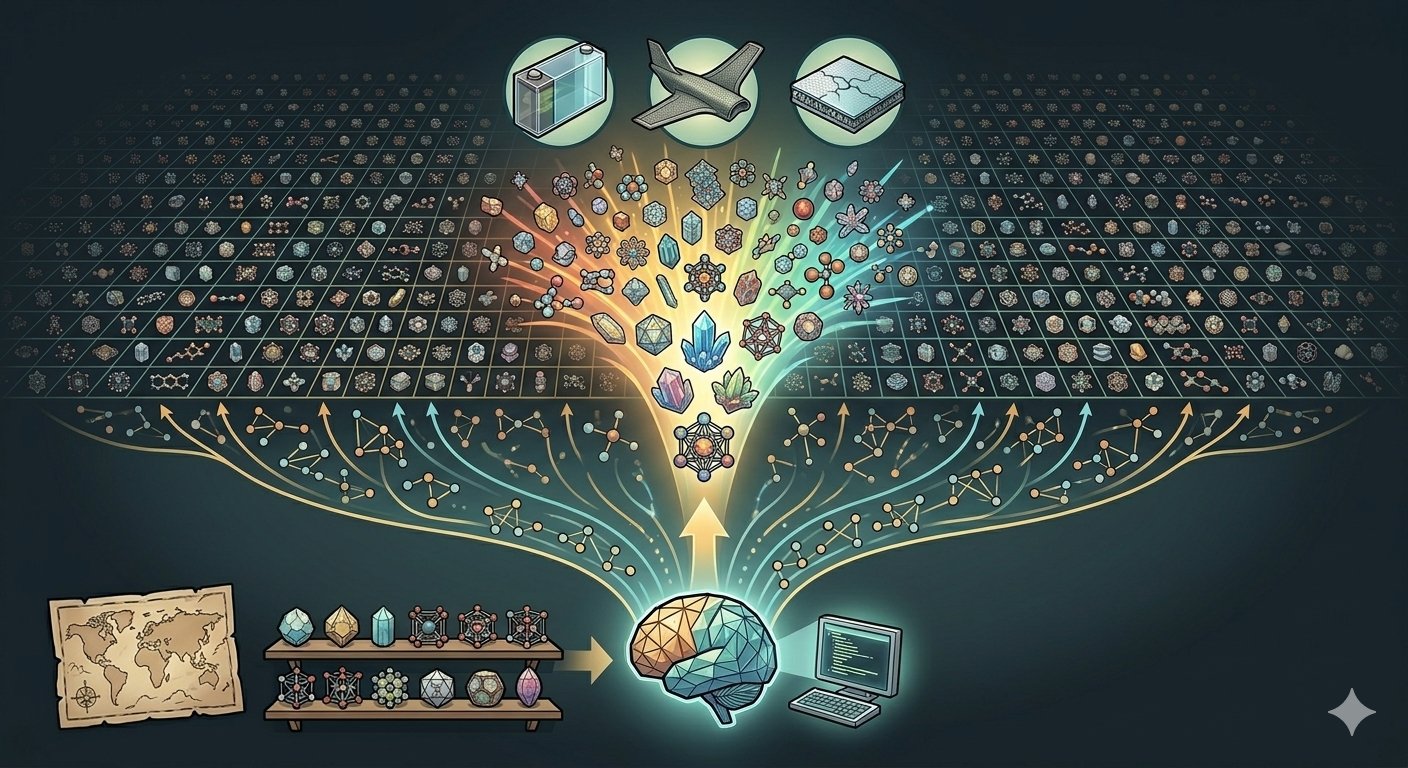
In November 2023, DeepMind published a list. It contained 2.2 million crystal structures.
Not compounds that had been synthesized. Not materials that had been tested. Structures that a machine learning model predicted would be stable, based on patterns in the physics of known crystals. Of those 2.2 million, roughly 380,000 were genuinely novel: compositions and arrangements that no one had made or computed before. The entire catalogue of stable inorganic crystals accumulated through human discovery up to that point numbered around 28,000.
That is the scale shift AI is introducing into materials science.
The old way of finding materials
Materials discovery has historically been a slow, expensive, and largely empirical process. You had a hypothesis, a synthesis route, and a furnace. You made something. You measured its properties. If it was useful, you refined it; if not, you tried something else. Thomas Edison tested over 6,000 candidate materials looking for a durable incandescent filament. That was the method: systematic elimination by experiment, guided by intuition and experience.
The process from initial discovery to commercial product averaged 10 to 20 years across the 20th century. Synthesis takes time. Characterization takes equipment. Iteration requires people. And the space of possible materials is vast almost beyond imagination: roughly 100 elements, capable of forming millions of distinct compositions, each in multiple possible crystal structures. Searching that space experimentally, one compound at a time, is equivalent to exploring an ocean by wading.
The US Materials Genome Initiative, launched in 2011, recognized this bottleneck explicitly. Its stated goal was to halve the time from discovery to deployment, using computational tools and data sharing. The initiative seeded a network of databases and tools that became the substrate for what happened a decade later when machine learning arrived.
What the models actually do
The core capability of modern ML in materials science is property prediction from structure. Given a crystal structure, a trained model can predict whether it's thermodynamically stable, what its electronic band structure looks like, what its thermal conductivity is, whether it might be magnetic, and dozens of other properties, in seconds, without running a single experiment or even a computationally expensive quantum chemistry calculation.
The models are trained on databases of computed materials properties: the Materials Project (now over 150,000 computed inorganic materials), AFLOW, and OQMD (Open Quantum Materials Database). These databases were built by running density functional theory (DFT) calculations, which are expensive but can be parallelized across supercomputer clusters. DFT is the physics-based ground truth. ML learns to approximate DFT's predictions much faster, trading some accuracy for enormous speed gains.
Graph neural networks (GNNs) are the dominant architecture for this task. A crystal structure maps naturally onto a graph: atoms as nodes, bonds and proximity relationships as edges. GNNs learn representations of local chemical environments and propagate information across the structure to predict global properties. Models like MEGNet, CGCNN, and GNoME are GNN-based. They've gotten good enough that predicted formation energies are within a few tens of meV per atom of DFT values for most compositions, which is sufficient to distinguish stable from unstable structures.
The generative side is newer and faster-moving. Rather than just predicting properties of proposed structures, generative models can propose novel structures with target properties. Variational autoencoders, diffusion models adapted from image generation, and large language models trained on materials databases can all generate candidate crystal structures or molecular compositions with specified characteristics. You tell the model you want a solid electrolyte with high ionic conductivity and a wide electrochemical window: it proposes candidates.
The loop that emerges: generate candidates, filter by predicted stability, rank by predicted performance, synthesize the top candidates, feed experimental results back into the training set, repeat. This is active learning: a closed-loop discovery workflow.
GNoME and what it means
DeepMind's GNoME paper in Nature in November 2023 is the most prominent recent example of this approach at scale. The model was trained on existing DFT-computed data from the Materials Project and similar databases, then used to generate and screen 2.2 million candidate crystal structures for thermodynamic stability.
The number is legitimately significant. It expanded the known space of stable inorganic crystals by roughly 80-fold. Many of the predicted materials fall into classes of interest for energy storage, superconductivity, and catalysis.
The verification step is equally important. Working with Lawrence Berkeley National Laboratory's A-Lab, the team autonomously synthesized 736 of the novel GNoME-predicted materials using a robotic laboratory system with minimal human intervention. 41% of synthesis attempts yielded the target phase. For novel compositions in unexplored spaces, that's a strong hit rate.
What GNoME doesn't do is tell you which of those 380,000 novel structures are useful for a specific application, how to make them at scale, or what their real-world performance looks like. Thermodynamic stability is a necessary but not sufficient condition for a useful material. There are compounds in those 2.2 million that will turn out to be genuinely important. Identifying which ones requires targeted follow-up, and the AI model hands that question back to human scientists.
Self-driving laboratories
The A-Lab at Berkeley is part of a broader shift toward autonomous experimental systems that ML drives rather than just informs.
A self-driving lab integrates robotic synthesis and characterisation with a machine learning model that proposes the next experiment based on results so far. The robot doesn't sleep. It doesn't have competing priorities. It runs 24 hours a day with consistent technique. The model learns in real time from every experiment it runs.
The Acceleration Consortium at the University of Toronto, led by Alán Aspuru-Guzik, has built one of the most advanced self-driving lab platforms. Their system has been used to find new organic molecules with specific photophysical properties, running thousands of experimental cycles in the time it would take a human team to run dozens. NIMS in Japan and Argonne National Laboratory have similar programs for inorganic materials.
The throughput advantage is real. But the more important advantage is exploration. A self-driving lab can pursue many parallel hypotheses without the cognitive constraints that push human researchers toward familiar chemical spaces. It goes to the parts of the composition map that intuition wouldn't.
Where the method runs into limits
Three problems are genuine and not trivially solvable.
Data quality is the most fundamental. ML models learn from training data, and materials databases are sparser, noisier, and less consistently curated than the datasets that trained large language models or image recognition systems. DFT has known systematic errors for certain classes of materials: strongly correlated electron systems, some transition metal oxides, surfaces. A model trained on imperfect data will have systematic blind spots, which become dangerous when the model is confident in predictions in those regions.
Synthesizability is a distinct problem from stability. Thermodynamic stability means the structure is at a free energy minimum. It says nothing about whether you can reach that minimum from starting materials at laboratory conditions. Many predicted stable structures are kinetically inaccessible: the synthesis pathway is blocked by energy barriers that room-temperature chemistry can't overcome. The GNoME paper's 41% synthesis success rate implicitly captures this: 59% of attempts failed, partly because the structures were real but unreachable by the synthesis routes tried.
Interpretability matters in practice. A model that predicts a high-performance lithium-ion cathode material without explaining which structural features drive the prediction gives the experimentalist no guidance for modification. Black-box predictions are useful for screening but insufficient for design. Explainability methods for GNNs have improved, but materials science needs predictions coupled with mechanistic insight, and most current models don't provide that reliably.
What this means for the materials scientist
The bottleneck in materials discovery is moving. It used to be at hypothesis generation and early-stage synthesis: finding the right composition to investigate. ML is compressing that step dramatically. The bottleneck is shifting downstream, toward experimental validation at scale, toward understanding why a promising material behaves as it does, and toward solving the engineering problems of manufacturing and integration that no model addresses.
A materials scientist in 2035 will spend less time running exploratory synthesis at small scale and more time running scale-up trials, analyzing anomalous ML predictions, curating training data for the next generation of models, and translating model outputs into manufacturable products. The analytical and creative work remains human-intensive. The combinatorial search work is increasingly machine-intensive.
This is analogous to what happened in genomics. DNA sequencing became cheap and fast enough to read entire genomes routinely. The bottleneck shifted from sequencing to interpretation: figuring out what the sequence means, which variants matter, how genes interact. Bioinformatics became an essential discipline. Materials informatics is following the same trajectory, roughly 15 years behind.
The tools are changing. The questions are not.
Where the series ends
This is the eighth and final article in the Materials Engineering Innovations series. We started with the glass on your phone screen and the foam in your running shoes: advanced materials hiding in plain sight, doing remarkable things without recognition.
We've covered materials that remember their shape and respond to temperature, the twenty-year audit of graphene's promises and deliveries, biomaterials designed to survive the immune response, the carbon problem embedded in cement and steel chemistry, the cost curve that turned carbon fiber from a fighter jet material into a bicycle frame, the chemistry bottleneck behind batteries and solar cells, and now the ML tools accelerating the search for whatever comes next.
The common thread across all eight articles is this: materials define what's possible. Every performance limit, every safety constraint, every cost ceiling in engineering ultimately traces back to the properties of the physical stuff things are made from. The machines get better. The software gets smarter. But the performance of every physical system, from an aircraft turbine blade to a solar cell to a hip implant, is bounded by material properties.
Those properties are being pushed, systematically, by people who understand them.
For more information or if you have any questions, please contact the author.
Written by Joshua U. Otaigbe, PhD