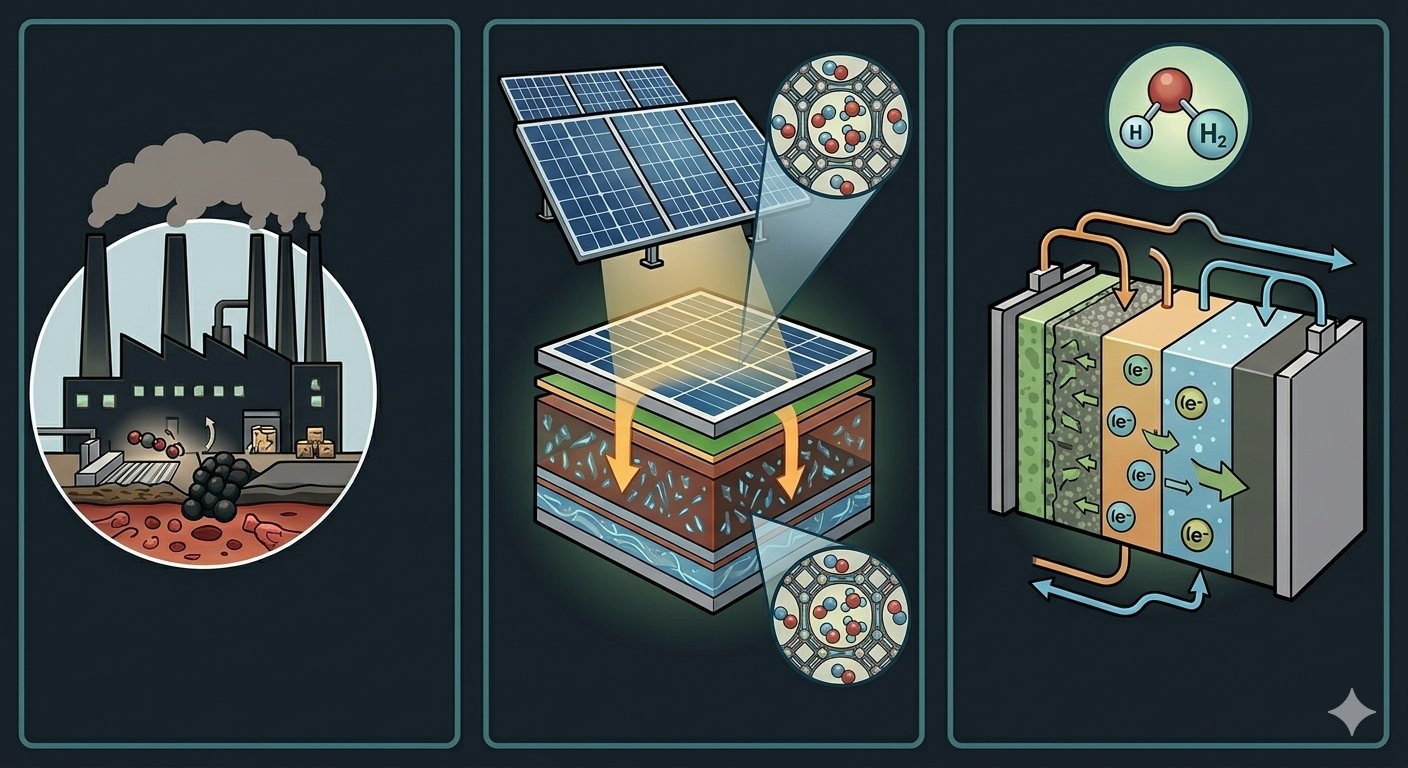
The energy transition is, at its core, a materials problem.
The physics of solar conversion, electrochemical storage, and hydrogen oxidation have been understood for decades. Photovoltaic cells work on principles described in the 1950s. The lithium-ion battery was commercialised in 1991. Proton exchange membrane fuel cells date to the 1960s. The equations governing these systems aren't under debate.
The limitation is that transforming those well-understood physical principles into devices that are cheap enough, durable enough, and energy-dense enough to displace the incumbent fossil fuel infrastructure requires materials that either don't exist yet or exist only at laboratory scale. Every percentage point of improvement in solar cell efficiency, every watt-hour per kilogram gained in battery energy density, and every order-of-magnitude reduction in electrocatalyst cost traces back to materials science.
Lithium-ion anatomy and its ceiling
A lithium-ion cell is a deceptively simple device. A cathode, an anode, and an electrolyte separating them, with a porous polymer membrane preventing contact. During charge, lithium ions move from cathode to anode through the electrolyte; during discharge, they move back. The current collectors, electrolyte, and separator are mostly inert scaffolding. The chemistry is in the active materials.
The cathode is where most of the energy density lives. NMC (lithium nickel manganese cobalt oxide) cathodes in high-energy EV cells now run at compositions like NMC 811 (80% nickel, 10% manganese, 10% cobalt), which deliver specific capacities around 200 mAh/g. Pushing nickel content higher increases capacity but reduces thermal stability, which is why every incremental nickel increase requires corresponding changes in electrolyte additives, electrode coatings, and battery management systems. LFP (lithium iron phosphate) cathodes are the other major chemistry: lower energy density (roughly 160 mAh/g), no cobalt or nickel, much better thermal stability and cycle life. BYD and CATL both rely heavily on LFP for lower-cost EVs and stationary storage.
The anode is where the physics gets interesting. Graphite, which intercalates lithium between its layers, has been the standard anode material since 1991. Its theoretical specific capacity is 372 mAh/g. Silicon's theoretical capacity is 3,579 mAh/g. The reason silicon hasn't replaced graphite is volumetric expansion: silicon expands roughly 300% as it absorbs lithium ions, creating stresses that crack the particles, expose fresh surface to electrolyte, and consume lithium in irreversible side reactions. The practical solution is partial substitution: silicon-graphite anodes with 5 to 20% silicon content by weight, capturing a meaningful capacity increase without the full expansion problem. Several manufacturers including Panasonic and CATL have commercial cells with silicon-containing anodes.
The electrolyte is a liquid organic carbonate solution, typically a mixture of ethylene carbonate and dimethyl carbonate, with a dissolved lithium salt (LiPF6). It works. It also burns. The organic carbonates are flammable, which is why lithium-ion battery fires are difficult to extinguish and why thermal runaway in a battery pack can propagate from cell to cell.
The energy density ceiling for conventional Li-ion, based on current cathode and anode chemistries, is approximately 300 to 350 Wh/kg at the cell level. Getting above that ceiling requires a different chemistry.
Solid-state batteries: the state of play
Replacing the liquid electrolyte with a solid changes almost everything about the cell design, most of it for the better on paper.
A solid electrolyte eliminates the flammable solvent. It enables a lithium metal anode, which has a theoretical specific capacity of 3,860 mAh/g versus graphite's 372 mAh/g. It allows cell operation over a wider temperature range. And it opens the door to bipolar stacking, which reduces inactive material and improves volumetric energy density at the pack level.
Ionic conductivity in solid electrolytes is lower than in liquid electrolytes at room temperature, though the gap has closed substantially. Sulfide-based solid electrolytes, particularly Li6PS5Cl (argyrodite), now achieve ionic conductivities of 10 to 25 mS/cm at room temperature, comparable to liquid electrolytes. Oxide-based electrolytes (LLZO: lithium lanthanum zirconium oxide) are chemically more stable but achieve lower conductivity unless carefully sintered. Polymer electrolytes (PEO-based) are processable and flexible but require elevated temperatures to achieve adequate conductivity.
The interface problem is harder. Solid-solid interfaces between the electrolyte and electrode materials generate resistance that liquid electrolytes avoid by conformally wetting every surface. Mechanical contact degrades as electrodes expand and contract during cycling. Lithium dendrites, considered a solved problem with solid electrolytes, can still grow through solid electrolytes at current densities above a threshold that varies with electrolyte grain structure and applied pressure.
Toyota has committed to production vehicles with solid-state batteries by 2027 or 2028 using a sulfide-based chemistry. QuantumScape, backed by Volkswagen Group, has demonstrated impressive cycle life in small-format cells and has broken ground on a pilot production facility in Germany. Solid Power, backed by Ford and BMW, is at a similar stage. The manufacturing challenge is underappreciated in most coverage: sulfide electrolytes are moisture-sensitive and require dry-room processing significantly more stringent than current Li-ion manufacturing.
The honest timeline for solid-state batteries in mass-market EVs is 2028 to 2033 for early commercial volumes, later for broad deployment. First-mover applications will be premium vehicles and aerospace, where the energy density and safety gains justify the cost premium.
Perovskite solar cells: fast climb, hard landing
Silicon photovoltaics have dominated solar for 40 years and remain the cheapest source of electricity ever produced in human history. The average cost of utility-scale solar in the US fell below $0.03 per kWh in 2023. The efficiency record for silicon solar cells is around 27%.
Perovskite solar cells are the most significant photovoltaic development since silicon, and they arrived fast. In 2009, a perovskite-structured material (methylammonium lead iodide) was reported as a solar cell sensitizer with 3.8% efficiency. By 2023, single-junction perovskite cells exceeded 26% efficiency in certified measurements. LONGi set a certified record of 33.9% efficiency for a perovskite-silicon tandem cell in late 2023. For reference, the thermodynamic efficiency limit for a single-junction silicon cell is around 29%.
The perovskite structure (ABX3, where A is an organic or inorganic cation, B is usually lead, and X is a halide) is fabricated from solution at relatively low temperatures, which means it can be printed or coated onto substrates rather than requiring the high-purity silicon ingot growth that makes silicon cells capital-intensive. The bandgap is tunable by varying the halide composition, which is why perovskite-silicon tandems are attractive: the perovskite top cell absorbs high-energy photons that silicon would waste as heat, and the silicon bottom cell captures lower-energy photons that the perovskite would miss.
Lead-containing perovskites decompose on contact with moisture and under prolonged UV exposure. Commercial silicon cells carry 25-year performance warranties. No perovskite cell has yet demonstrated comparable outdoor durability, though cells encapsulated with careful moisture barriers now routinely achieve 2,000 to 5,000 hours in accelerated aging tests. Replacing lead with tin produces cells with similar efficiency potential but worse stability, because Sn2+ oxidizes to Sn4+ more readily than Pb2+.
The scaling problem is distinct from the stability problem. Small-area certified efficiency records are measured on cells of a square centimeter or less. Commercial modules must cover square meters. Perovskite efficiency drops meaningfully when cells are scaled up, because coating uniformity over large areas is harder to maintain. Oxford PV, the most advanced commercial developer of perovskite-silicon tandems, has demonstrated module-level efficiencies above 24% and announced plans for commercial production.
A conservative commercial timeline: premium perovskite-silicon tandem modules available in limited quantities by 2025 to 2026, meaningful market penetration by 2028 to 2030, assuming stability is resolved. Lead-free perovskites are probably 5 to 10 years further behind.
Hydrogen storage: the unsolved weight problem
Hydrogen is a compelling energy carrier. Its gravimetric energy density is 33 kWh/kg, roughly 3 times that of diesel. It produces only water when oxidized in a fuel cell. Green hydrogen, produced by electrolysis using renewable electricity, has near-zero lifecycle carbon emissions.
The problem is storing it. At room temperature and atmospheric pressure, hydrogen gas has an energy density of about 3 Wh/L. Diesel is 9,700 Wh/L.
The two approaches in commercial vehicles are compressed gas (700 bar in Type IV carbon fiber composite tanks, as used in the Toyota Mirai and Hyundai Nexo) and liquid hydrogen stored at -253°C. Compressed tanks at 700 bar achieve volumetric energy densities around 1.3 kWh/L. Liquid hydrogen reaches about 2.4 kWh/L, at the cost of roughly 30% of the hydrogen's energy content for liquefaction and continuous boil-off losses during storage.
Metal hydrides absorb hydrogen into a crystal lattice, achieving volumetric densities that exceed liquid hydrogen in some materials. Magnesium hydride (MgH2) has a gravimetric capacity of 7.6 wt%, meeting the US DOE's target of 6.5 wt% for onboard storage. The problem is operating temperature: MgH2 releases hydrogen only above 300°C, with slow kinetics. Practical metal hydrides for vehicles need to work near room temperature, and the best room-temperature materials (FeTi, LaNi5) store only 1 to 2 wt%, not enough for useful vehicle range without a very heavy tank.
Liquid organic hydrogen carriers (LOHCs), such as dibenzyltoluene, can be hydrogenated to absorb hydrogen and dehydrogenated at a refuelling station to release it. They're compatible with existing liquid fuel infrastructure. The dehydrogenation step requires heat at around 300°C, which fits some industrial applications better than vehicle applications.
The honest assessment: no hydrogen storage technology currently meets all requirements simultaneously. For light vehicles, compressed 700 bar tanks are the pragmatic current answer. Progress on room-temperature metal hydrides continues, but a vehicle-level solution isn't imminent.
What's closest to commercial viability
LFP batteries for stationary storage and budget EVs are already commercial and growing fast. Silicon-dominant anodes at 20 to 40% silicon are arriving in volume production cells now. These are the near-term gains: real, incremental, and meaningful at gigawatt-hour scale.
Solid-state batteries will reach premium EV applications by the end of this decade, starting with Toyota and one or two Korean manufacturers. Mass market will follow when manufacturing costs fall.
Perovskite-silicon tandem solar modules will reach market in limited quantities within 2 to 3 years, assuming Oxford PV and LONGi deliver on their roadmaps. The efficiency advantage over standard silicon justifies a cost premium in space-constrained applications.
Hydrogen storage remains the least-solved problem in this group. The physics of the molecule are the constraint.
The pattern across all of these is consistent with what this series has returned to repeatedly: the physics is understood, the performance targets are defined, and the path forward is a manufacturing and materials engineering problem. The chemistry and engineering of the energy transition will be solved in labs and factories, not boardrooms.
For more information or if you have any questions, please contact the author.
Written by Joshua U. Otaigbe, PhD