For most of engineering history, a material's properties were set by its chemistry. Steel is stiff because of its metallic bonding; rubber stretches because of its long, flexible polymer chains; glass is transparent because of how its structure interacts with light. Engineers chose materials, then designed around their fixed behavior.
Two related developments are changing that relationship. Metamaterials derive their properties from engineered structure rather than composition, making it possible to create behaviors that do not occur in ordinary materials. Self-healing and stimulus-responsive materials can sense damage or environmental change and respond, repairing cracks or adjusting their properties. Together they point toward materials that are designed, not just selected, and that adapt over their service lives. Some applications are already practical; others remain at the research stage. Understanding the difference is essential for anyone considering them for real products.
Metamaterials: properties from architecture
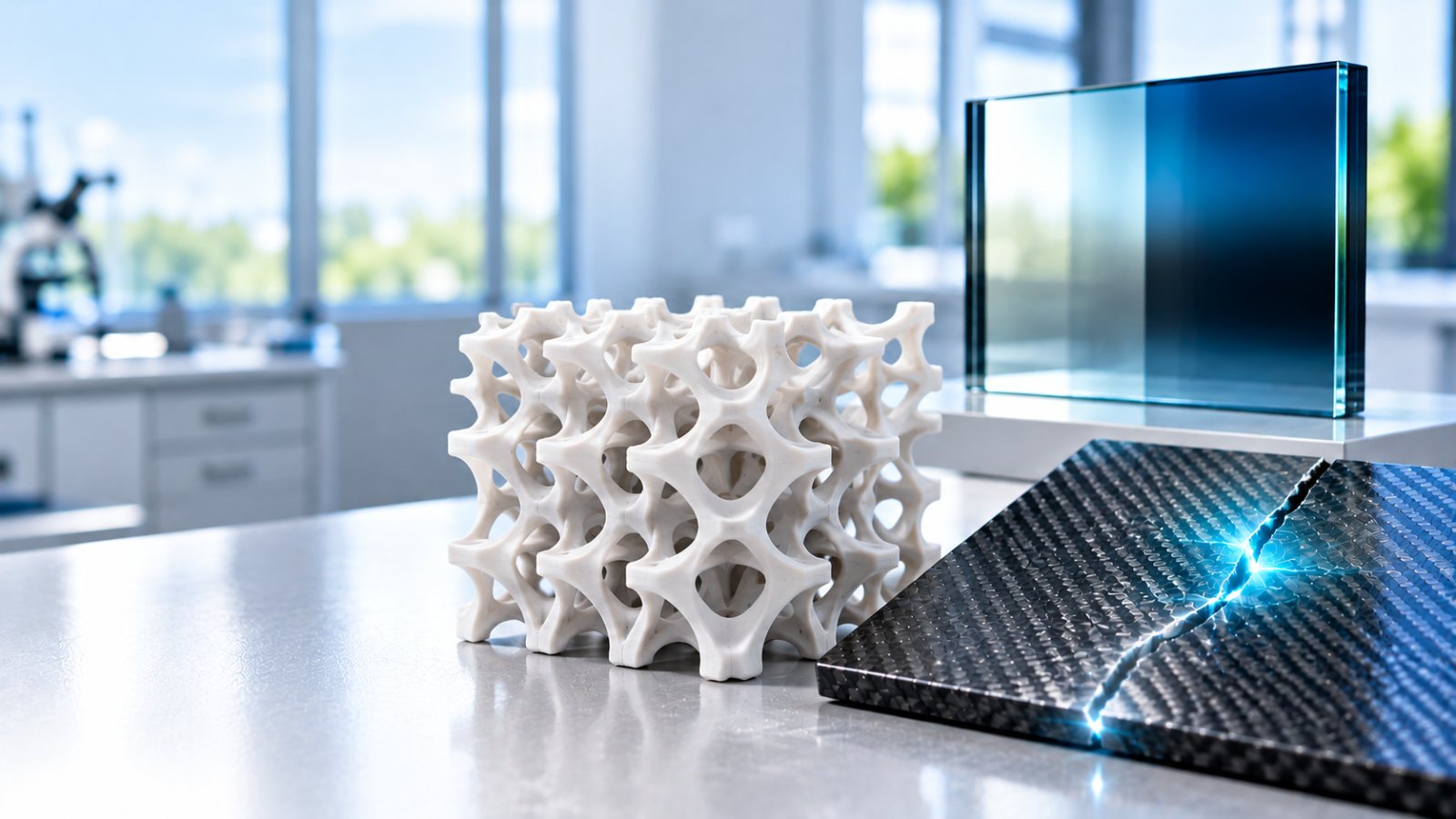
A metamaterial is an engineered structure, usually a repeating arrangement of cells smaller than the scale of the phenomenon it controls, whose behavior emerges from geometry. The same base material arranged in different architectures can behave very differently.
Mechanical metamaterials and auxetics
Most materials become thinner when stretched; their Poisson's ratio is positive. Auxetic materials do the opposite: they become wider when stretched and contract when compressed, a negative Poisson's ratio achieved through re-entrant, rotating or chiral cell geometries. This unusual behavior brings practical benefits: improved indentation resistance, because material flows toward an impact point rather than away from it; enhanced energy absorption; and the ability to conform to curved surfaces.
Applications under development and in early use include protective equipment, footwear midsoles, impact-absorbing structures, medical stents and implants, and lightweight structural cores. Additive manufacturing has made complex lattice architectures far more practical, allowing designers to tailor stiffness, energy absorption and weight locally within a single part.
Acoustic and optical metamaterials
Acoustic metamaterials manipulate sound and vibration through resonant structures, enabling thin, lightweight panels that block low-frequency noise that conventional materials struggle with. These have clear potential in vehicles, aircraft, buildings and machinery. Optical and electromagnetic metamaterials can bend light and radio waves in unusual ways, supporting flat lenses, antenna designs and, in carefully controlled laboratory conditions, demonstrations of cloaking over narrow wavelength ranges. Broadband invisibility for practical objects remains far from reality, but the underlying principles are already improving antennas, sensors and optical components.
Smart and responsive coatings
Stimulus-responsive coatings change their properties in response to temperature, light or electrical signals. Thermochromic coatings, often based on vanadium dioxide or organic systems, change optical properties as temperature changes, and can be designed to reflect more solar heat when hot and transmit more when cool. Electrochromic glazing, which changes tint under an applied voltage, is already used in commercial buildings. Radiative cooling coatings, engineered to reflect sunlight while emitting heat through the atmosphere's infrared window, can cool surfaces below ambient temperature without power.
For buildings, these technologies offer potential reductions in cooling and heating energy. The engineering questions are durability under years of sunlight, temperature cycling and weather, consistency of switching performance over time, and cost relative to conventional glazing and coatings.
Self-healing materials
Self-healing materials repair damage autonomously or with a simple trigger, extending service life and improving reliability. Two main strategies dominate.
Extrinsic healing: capsules and vascular networks
In the approach pioneered by researchers at the University of Illinois in 2001, a polymer contains microcapsules filled with a liquid healing agent, along with a dispersed catalyst. When a crack forms, it ruptures capsules, releasing the healing agent into the crack, where it polymerizes and bonds the crack faces. Vascular systems extend the idea, using networks of channels that can deliver healing agent repeatedly. These approaches are effective for repairing microcracks, but each capsule can heal only once, and capsules must be compatible with processing and service conditions.
Intrinsic healing: reversible chemistry
Intrinsic self-healing materials use reversible bonds, including hydrogen bonds, ionic interactions, and dynamic covalent bonds similar to those in vitrimers, that can break and reform. Healing may occur at room temperature or require heat, light or pressure. Because the healing chemistry is built into the material, repeated healing is possible.
Composites are a major target, because delamination and microcracking in fiber-reinforced polymers are difficult to detect and repair. In 2026, researchers at North Carolina State University reported a fiber-reinforced composite with a 3D-printed thermoplastic healing agent and embedded heater layers that can repair delamination more than 1,000 times when triggered, though healing efficiency declines gradually with repeated cycles. Results like this point to composite structures whose service life is extended by periodic in-place repair.
Self-healing concepts are also being applied to concrete, through bacteria that precipitate calcium carbonate or encapsulated healing agents that seal cracks, and to protective coatings, where healing can restore barrier properties after scratches. Some self-healing coatings and elastomers are already commercial.
What changes in engineering practice
Designing with architected materials and self-healing systems requires some changes to familiar engineering habits. Conventional design assumes a material with tabulated properties, such as modulus, strength and density, that can be looked up and used in calculations. A lattice metamaterial has effective properties that depend on cell geometry, cell size, strut thickness, the base material and the manufacturing process, and those properties may differ by direction. Designers therefore need validated models linking architecture to behavior, along with test data on printed samples, because additive manufacturing introduces surface roughness, porosity and dimensional variation that can shift performance significantly.
Self-healing materials raise a different design question: how much credit should healing receive? A structure designed to tolerate damage until the next inspection is a well-understood concept. A structure that partly repairs itself between inspections complicates damage tolerance calculations, because healed strength may be lower than original strength and may decline with repeated healing. Until standards and certification practices develop, many engineers will treat healing as an added margin rather than as a substitute for conventional design allowances. That conservative approach makes adoption easier in the near term while experience accumulates.
The engineering reality check
These materials offer real benefits, but adoption depends on answering practical questions:
- Trade-offs in base properties. Adding capsules, vascular networks or dynamic bonds can reduce stiffness, strength or creep resistance. Lattice metamaterials may have lower absolute strength than solid materials. Benefits must outweigh these costs.
- Healing conditions and limits. What size of damage can be healed, under what conditions, how many times, and with what recovery of properties?
- Durability over service life. Do capsules, catalysts, responsive chemistries and lattice structures survive aging, fatigue, temperature extremes and environmental exposure?
- Manufacturing scale and cost. Can complex architectures and healing systems be made reliably at production volumes and acceptable cost?
- Qualification and certification. Aerospace, building and infrastructure applications require extensive testing and certification. How will healing performance be verified and credited in design?
- Inspection. If a structure heals, how do inspectors know damage occurred and was repaired effectively?
The last question is especially important for safety-critical structures. Regulators and engineers will need confidence that self-healing does not mask damage that should be investigated.
Where the near-term value lies
The most promising near-term opportunities tend to be where the benefits are clear and certification hurdles manageable: additively manufactured lattices for energy absorption and lightweighting in consumer and industrial products; acoustic panels in vehicles and buildings; smart glazing and radiative cooling coatings in buildings; and self-healing coatings and elastomers that extend maintenance intervals. Structural self-healing composites in aircraft and infrastructure will take longer, but research progress suggests they are moving steadily toward practical use.
For product developers, the opportunity is to think of structure and responsiveness as design variables. Asking what a part would gain if it could absorb energy differently, block a specific frequency, change its thermal behavior or repair its own damage can open design options that conventional materials selection would never reveal.
If you are exploring metamaterials, smart coatings or self-healing materials for your products, Flaney Associates provides independent product development and materials innovation support, from feasibility assessment to testing and qualification strategy. Discuss Your Challenge at flaneyassociates.com/contact.html or Get the Checklist at flaneyassociates.com/checklist.html.
Written by Joshua U. Otaigbe, PhD